Adinandra dumosa Jack
| Etymology | Genus | From Greek, Crowded (Adinos) man (aner), referring to the crowded stamens |
|---|---|---|
| Species | Shrubby | |
| Family | Pentaphylacaceae | |
| Synonyms | Adinandra cyrtopoda Miq., Adinandra trichocoryna Korth. | |
| Common Names | Tiup-Tiup, Tetiup | |
| Status | Native: Least Concern | |
| Form | Tree | |
| Native Distribution | West Malesia | |
Diagnostics
A tree of up to 18m, Adinandra dumosa is the dominant species in the Adinandra belukar forest, the forest type in Kent Ridge. The leaves are very easily identifiable; being folded upwards along the mid-vein, with the entire leaves also pointing upwards along the branch. The leaves also have indistinguishable secondary venation. The new leaves are yellowish to reddish in colour.
Interesting Facts
Tiup-Tiup is such a common tree in the Adinandra belukar that the forest type is named after it! Its flowers usually does not open at all thus suspected by Corner (1997) to be self-pollinated. The seeds are dispersed by small fruit bats which suck out the pulpy contents of the fruit and disgorge the seeds (Corner, 1997).

One of the many Tiup-Tiup trees in Kent Ridge.

Bark, mostly gaining a rusty color from fungus.

Characteristic upward pointing leaves.
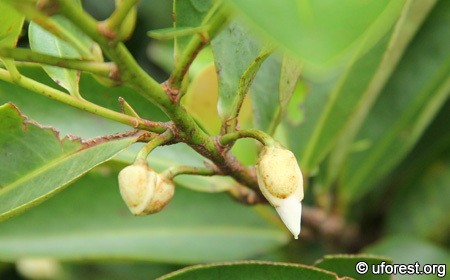
The white flower is almost always unopen.

Flower (right) and fruit (left).