Andira inermis (W. Wright) Kunth ex DC.
| Etymology | Genus | From the Brazilian common name for these trees |
|---|---|---|
| Species | Non-spiny | |
| Family | Fabaceae | |
| Synonyms | Andira jamaicensis (Wright) Urb., Geoffroea inermis Wright | |
| Common Names | Brown Heart, Cabbage Tree, Angelin | |
| Status | Exotic: Casual | |
| Form | Tree | |
| Native Distribution | Tropical Africa and America | |
Diagnostics
Andira inermis is a cultivated tree with a dense crown. The distinctive feature comes from its imparipinnate compound leaves, and that each leaflet has very wavy margins. The inflorescence come in a cluster of tiny purple flowers situated terminally at the branches.
Interesting Facts
The Brown Heart is first introduced into the Botanic Gardens, and subsequently a common roadside tree (Rao & Wee, 1989). However, its popularity have declined because of its susceptibility to basal rot, and therefore it is being gradually phased out from the streetscape (Wee, 2003). Bats feed on the succulent husk of the fruits and thus aid in their dispersal (Wee, 2003).
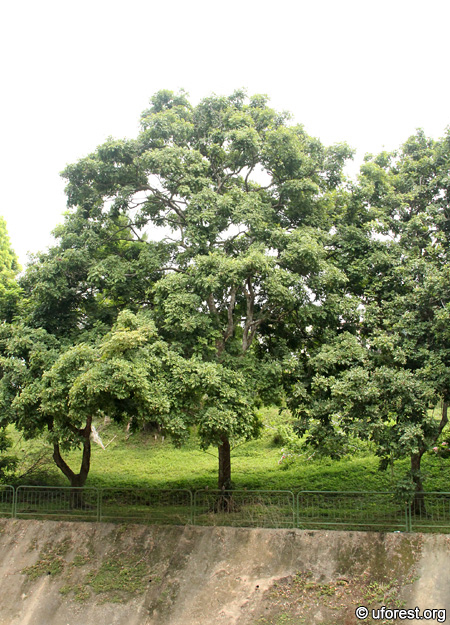
Form of the Brown Heart.
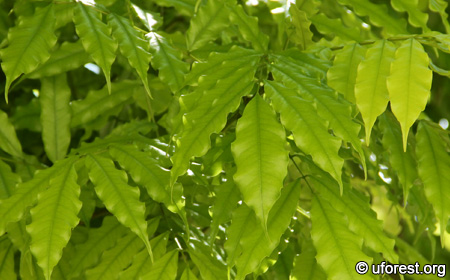
The distinctive wavy margins of the leaflets.
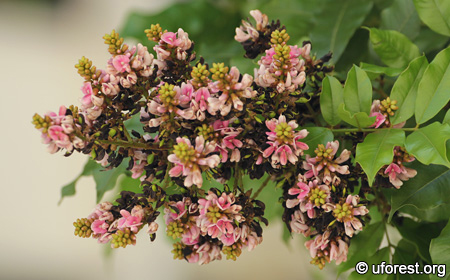
Purple inflorescence and flower closed-up.
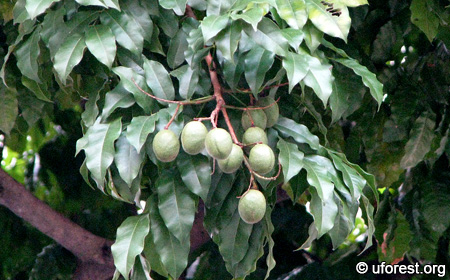
Fruits are rounded and single-seeded.
References
Rao AN & WC Wee (1989) Singapore Trees. Singapore Institute of Biology, Singapore. 357 pp.Wee YC. (2003) Tropical Trees and Shrubs: A Selection for Urban Planting. Sun Tree Publishing, USA. 392 pp.