Cyathula prostrata (L.) Blume
| Etymology | Genus | Small cup |
|---|---|---|
| Species | After prostrate; referring to the low lying form | |
| Family | Amaranthaceae | |
| Synonyms | Achyranthes prostrata L. | |
| Common Names | Pasture Weed, Hookweed, Nyarang | |
| Status | Native: Least Concern | |
| Form | Herb | |
| Native Distribution | Pantropical and subtropical | |
Diagnostics
A prostrate herb up to 30-50cm. It has opposite leaves, and reddish quadrangular stems. The stem, leaf margins and veins are covered with white hairs.
Interesting Facts
Cyathula prostrata is used as a traditional medicinal herb across Africa and Asia for various digestive and inflammatory ailments (Chuakul et al., n.d.). The plant exhibits significant pharmacological properties, including analgesic, anti-inflammatory, and antimicrobial activities, which are attributed to its rich content of saponins and flavonoids (Uahomo et al., 2022; Ibrahim et al., 2012).
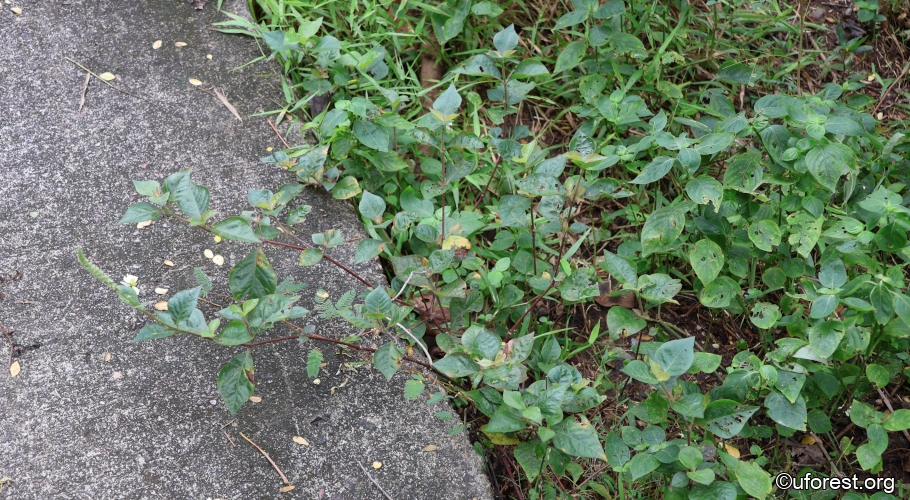
Growing at a grass patch, likely cultivated in Hougang (2026).
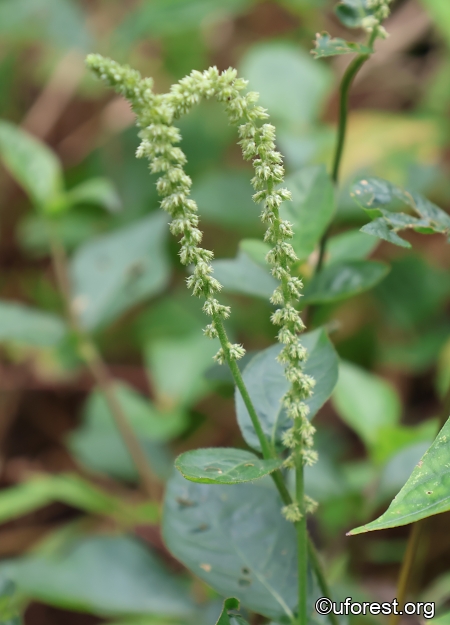
Inflorescence spikes.
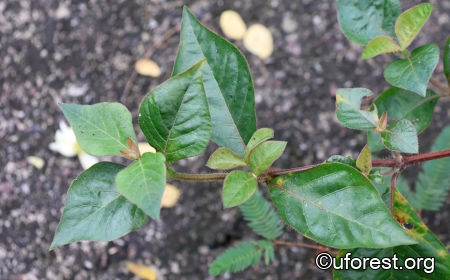
Leaves.
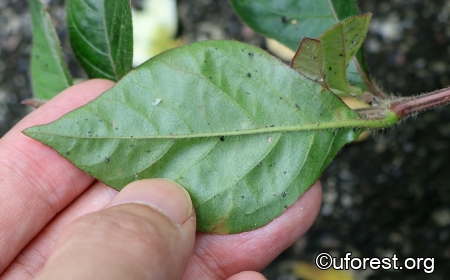
Leaf underside.
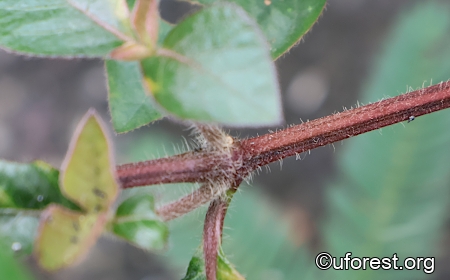
Angular red stem.
References
Chuakul, W., Soonthornchareonnon, N., & Ruangsomboon, O. (n.d.). Cyathula prostrata (PROSEA). https://plantuse.plantnet.org. Accessed on 21-Feb-2026.
Uahomo, P., Isirima, J. C., & Akoko, S. (2022). Evaluation of phytochemicals and bioactive properties in leaf and root parts of Cyathula prostrata (pasture weed) - a qualitative and quantitative analysis. Asian Plant Research Journal, 9(3), 8-16.
Ibrahim, B., Sowemimo, A., van Rooyen, A., & Van de Venter, M. (2012). Antiinflammatory, analgesic and antioxidant activities of Cyathula prostrata (Linn.) Blume (Amaranthaceae). Journal of Ethnopharmacology, 141(1), 282-289.