Cyperus rotundus L.
| Etymology | Genus | After the Greek common name of the sedge, "kuperos" |
|---|---|---|
| Species | Round or fat; perhaps referring to its tubers | |
| Family | Cyperaceae | |
| Synonyms | Chlorocyperus rotundus (L.) Palla, Pycreus rotundus (L.) Hayek, Cyperus maritimus Bojer | |
| Common Names | Nut Grass, Coco Grass, Purple Nut Sedge | |
| Status | Native: Least Concern | |
| Form | Herb | |
| Native Distribution | Eurasia | |
Diagnostics
Cyperus rotundus is a very common sedge found in lawns and scrublands. The flowering stem is triangular while its leaves which wrapped around the stem at the base are grooved at the mid-vein. The inflorescence is most distinctive, where the linear spikelets are reddish-brown in colour.
Interesting Facts
The Nut Grass is so known because it has a swollen underground tuber, resembling the shape of a peanut (note that the peanut itself is a fruit, not a tuber). It is regarded as one of the world's worst weeds in agricultural areas (Holm et al., 1977).

Form of the Nut Grass is common in lawns and scrublands.
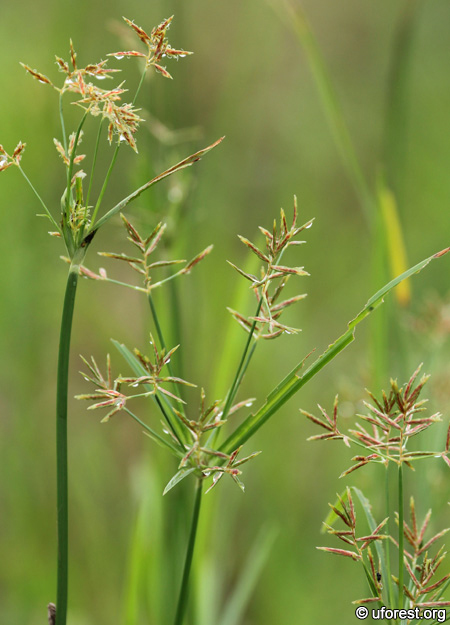
Structure of the inflorescence.
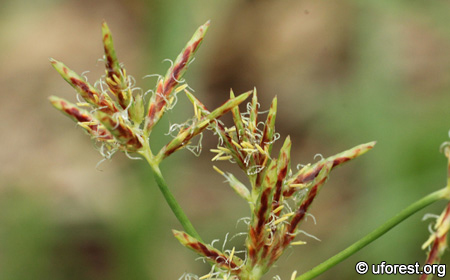
The spikelets are reddish brown.

The stem of the sdege is triangular.
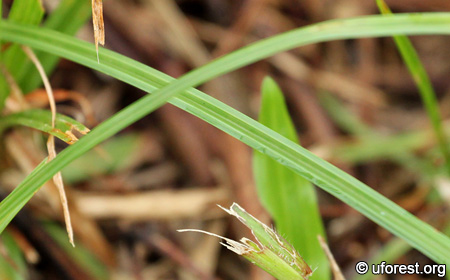
The leaves are grooved at the middle.
References
Holm LG, Plucknett DL, Pancho JV & Herberger JP. (1977) The world's worst weeds: distribution and biology. East-West Center, University Press of Hawaii. 609 pp.
Siyang ·
2013-05-12 / Modified: 2025-10-28