Dipteris conjugata Reinw.
| Etymology | Genus | From Greek, di (two) and pteris (a fern), referring to the deeply bilobed fronds |
|---|---|---|
| Species | Joined in pairs | |
| Family | Dipteridaceae | |
| Synonyms | - | |
| Common Names | Paku Payung, Bua Chek | |
| Status | Native: Critically Endangered | |
| Form | Herb | |
| Native Distribution | Southeast Asia, Australia | |
Diagnostics
This is a critically endangered fern that is presently found at three locations at Pulau Tekong and parts of Western Catchment area (Lok et al., 2009). It is naturally found on slopes or cliffs, in forests or facing the sea. It spreads vegatatively via long creeping rhizomes, allowing it to carpet an entire area. Together with its habitat preference, the leaves are also immediately identifiable with deeply lobed fronds bearing serrated margins.
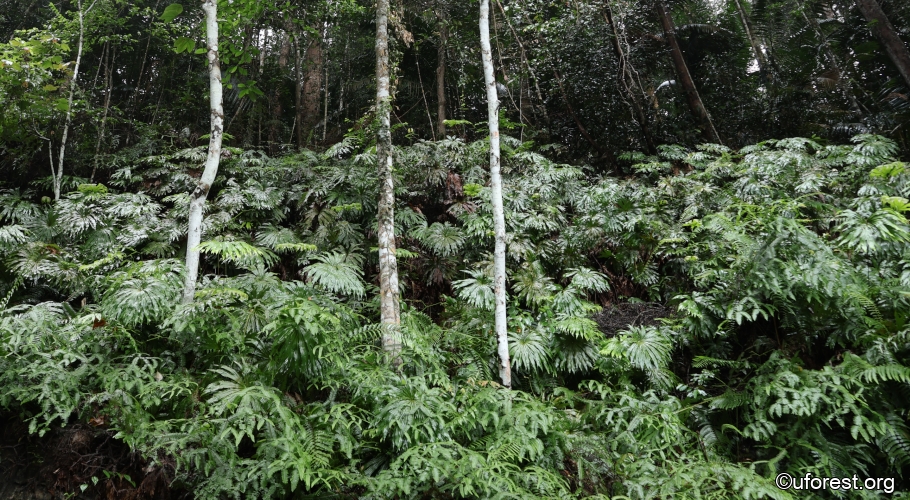
Sprawling cover along the main road at Penang Hill, 2025.
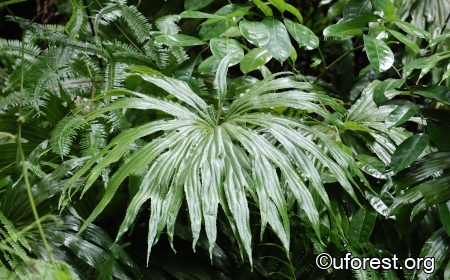
Frond.
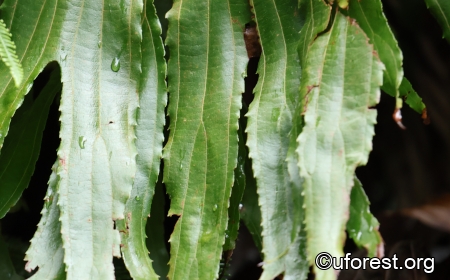
Serrated margins.
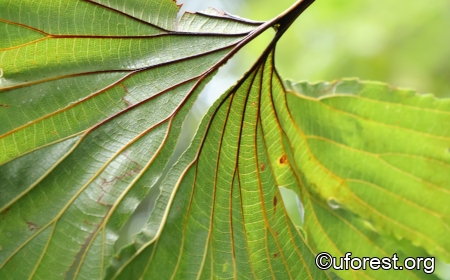
Underside.
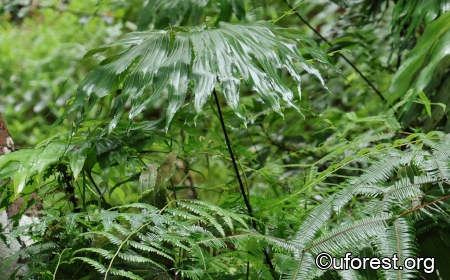
Leaf stalk.
References
Lok, A. F. S. L., Ang, W. F., & Tan, H. T. W. (2009). The status and distribution in Singapore of Dipteris conjugata Reinw. (Dipteridaceae). Nature in Singapore, 2, 339–345.