Dracaena cantleyi Baker
| Etymology | Genus | Greek: 'drakaina'= female dragon. The red resin produced by this genus is known as 'dragon's blood'. |
|---|---|---|
| Species | After Nathaniel Cantley, superintendent of the Singapore Botanic Gardens from 1880-1888. | |
| Family | Asparagaceae | |
| Synonyms | Dracaena aurantiaca (Baker) Wall. ex Hook.f. | |
| Common Names | Cantley's Dracaena | |
| Status | Native: Endangered | |
| Form | Shrub | |
| Native Distribution | Peninsular Malaysia, Singapore, Borneo | |
Diagnostics
The leaves are oblanceolate and without leaf stalks (sessile). They can be up to a metre long, and are typically clustered towards the ends of the branches. The leaves are often attractively-variegated with white, yellow, or purple spots, making this species quite striking and recognisable. This plant is a shrub that can be 2 to 3 metres tall.
Interesting Facts
The extract from the leaves of this plant have anti-inflammatory properties, and scientists have documented orang utans in Borneo chewing up the leaves and applying the pulp onto their arms and legs, apparently to relieve bodily aches (Morrogh-Bernard et al. 2017). Members of the Dracaena genus are prized for their ornamental value in the Chinese culture as they are believed to be auspicious plants that bring good fortune and prosperity.
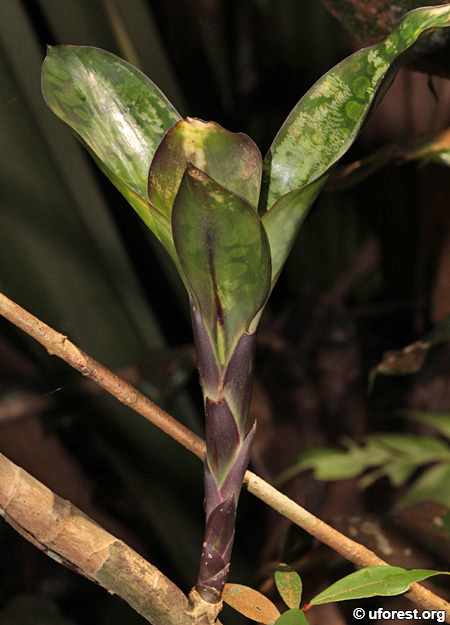
Leaves arranged in a rosette
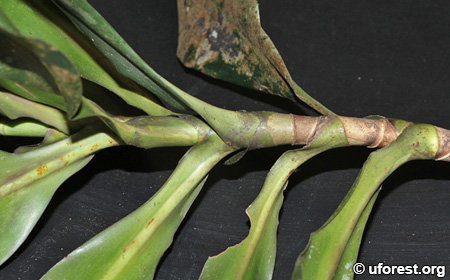
The leaves are sessile and borne directly on the stem without leaf stalks
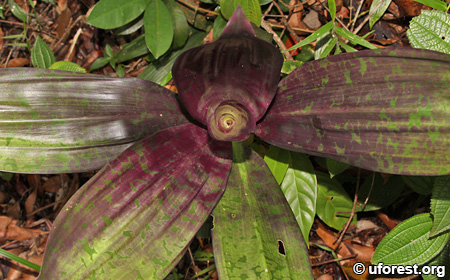
Attractive variegation on the leaves
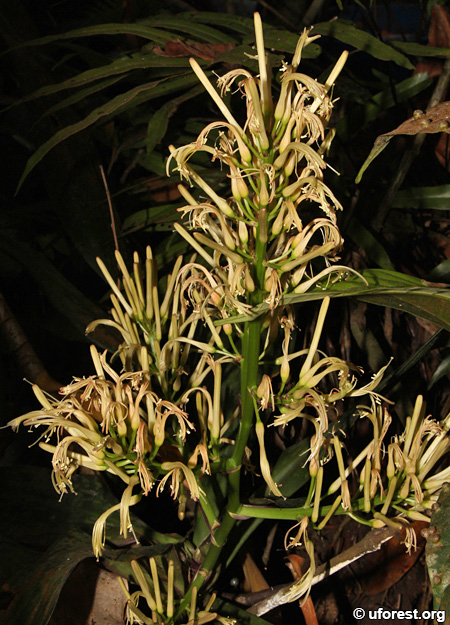
Many-branched flowering stalk
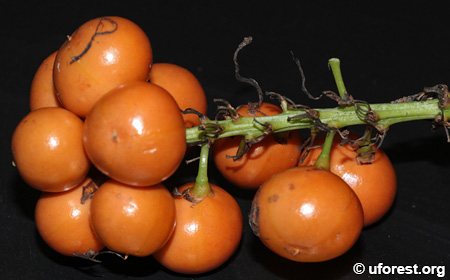
Ripening fruits
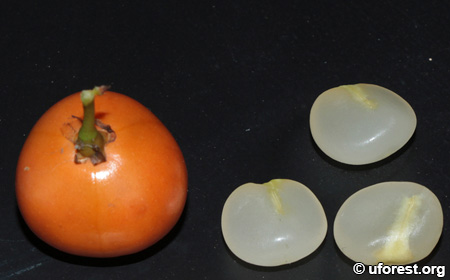
Fruit sections
References
Morrogh-Bernard et al. (2017) Self-medication by orang-utans (Pongo pygmaeus) using bioactive properties of Dracaena cantleyi, Nature 7: 16653, DOI:10.1038/s41598-017-16621-w
Tan H.T.W. & Giam X. (2008) Plant Magic: Auspicious and Inauspicious Plants from Around the World. Marshall Cavendish International (Asia) Private Limited, Singapore. 215 pp.