Falcataria falcata (L.) Greuter & R.Rankin
| Etymology | Genus | Curved; likely referring to the leaflets |
|---|---|---|
| Species | - | |
| Family | Fabaceae | |
| Synonyms | Falcataria moluccana (Miq.) Barneby & J.W.Grimes , Albizia falcataria (L.) Fosberg, Albizia moluccan | |
| Common Names | Albizia | |
| Status | Exotic: Naturalised | |
| Form | Tree | |
| Native Distribution | Indonesia, New Guinea, and Solomon Islands | |
Diagnostics
Falcataria moluccana is often the dominating tree species found in our young secondary forests. It can grow up to 50 meters tall and have huge smooth trunks which are light grey (Rao & Wee, 1989). A solitary tree growing without competition will show its diagnostic multiple foliage layers.
Interesting Facts
Albizia was first introduced to Singapore from Java to the Singapore Botanic Gardens in 1871 (Rao & Wee, 1989). It is extremely fast growing, growing up to 15 meters in just 3 years under good conditions (Corner, 1997). However, the wood density is low as a result and very susceptible to breakage. Together with its shallow root system, it quickly fell out of favour as a an ornamental tree here, but not before naturalising into our natural habitats.
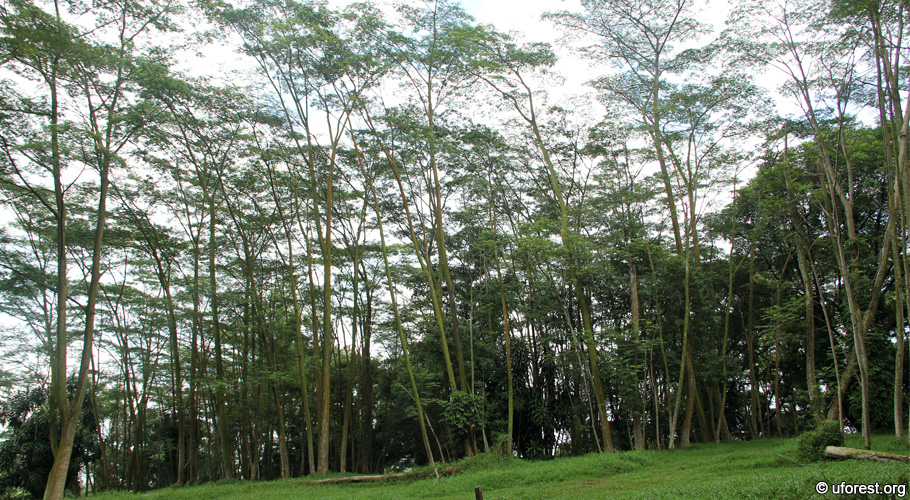
Albizia dominated forest at Bidadari Cemetery.
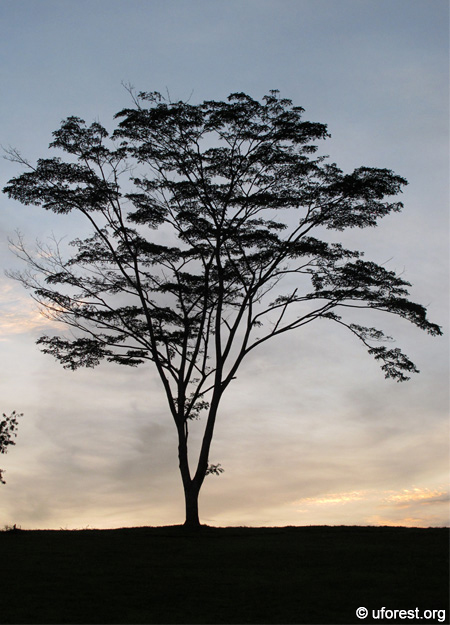
Silhouette of the Albizia showing the layering of the canopy.
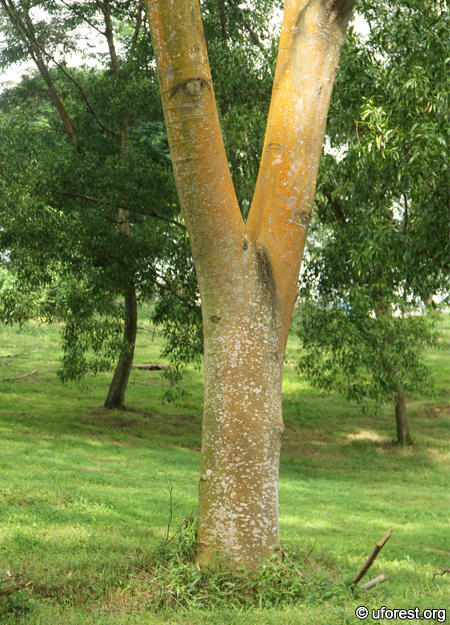
Bark is usually greyish white but frequently covered with a copper coat.
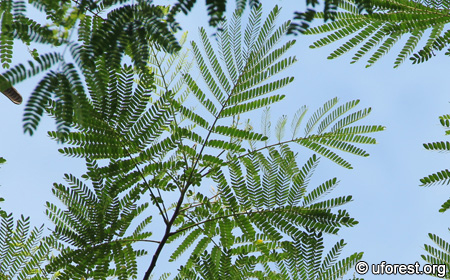
Leaves are bipinnate.
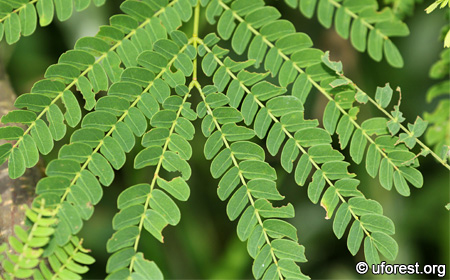
Leaflets.
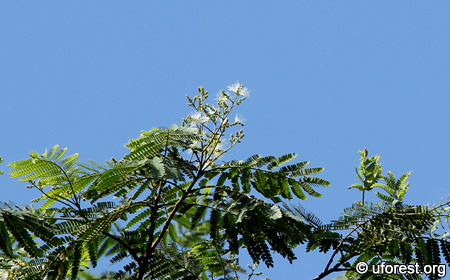
Flowers.
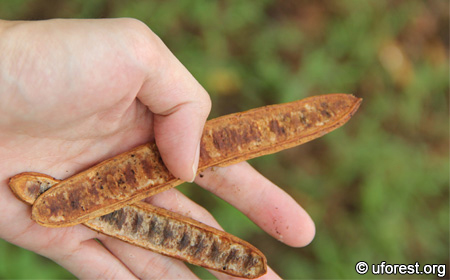
Fruits.
References
Corner EJH. (1997) Wayside Trees of Malaya. Volume 1. 4th edition. The Malaysian Nature Society, Kuala Lumpur. 476 pp.Rao AN & WC Wee (1989) Singapore Trees. Singapore Institute of Biology, Singapore. 357 pp.