Hippobroma longiflora (L.) G. Don
| Etymology | Genus | Horse (Hippo) fury (bromos); referring to its poison which can drive horses mad |
|---|---|---|
| Species | Long flower | |
| Family | Campanulaceae | |
| Synonyms | Lobelia longiflora L., Laurentia longiflora (L.) Peterm. | |
| Common Names | Star of Bethlehem, Madam Fate | |
| Status | Exotic: Naturalised | |
| Form | Herb | |
| Native Distribution | The Caribbean | |
Diagnostics
An easily recognisable herb because of its rosette leaf arrangement. Its leaves are pinnately-lobed, the margins are lined with teeth, and they lack a petiole. The mid-vein is also very prominent. The white flowers have a long stalk and are five-petalled. It prefers shady areas.
Interesting Facts
One has to be careful handling this plant as it contains a poisonous white sap (lobelanidine) that can cause irritation on contact. It also may even cause blindness if it gets onto the eye, and give a burning sensation when ingested (FloraFaunaWeb, 2010).
The Star of Bethlehem is widely cultivated as an ornamental plant, and likely as a result, also naturalised in many tropical and subtropical countries (eFloras, 2008).
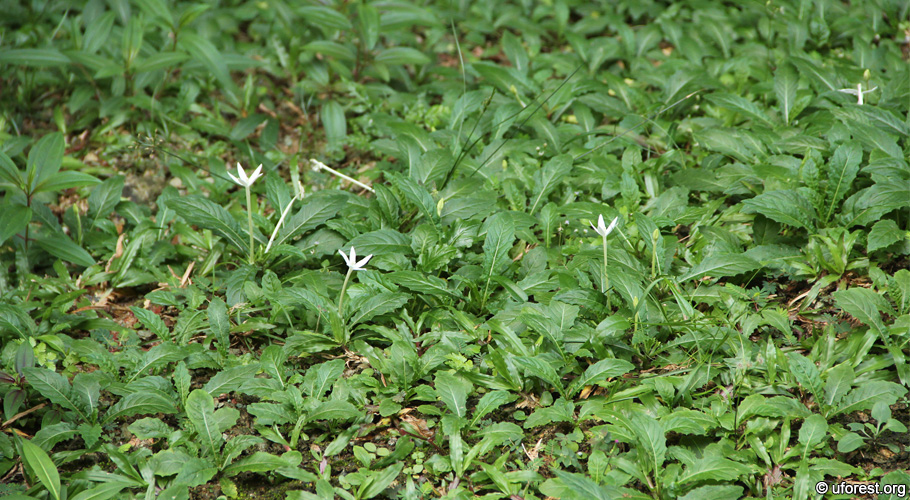
A patch of lawn covered by Hippobroma longiflora in the National University of Singapore.

Side view showing its short stem.

Pinnately-lobed leaves are lined with teeth.

Flower resembles a star; hence the common name, Star of Bethlehem.
References
eFloras. (2008) Hippobroma longiflora (Linnaeus) G. Don, Gen. Flora of China. Missouri Botanical Garden, St. Louis, MO & Harvard University Herbaria, Cambridge. http://www.efloras.org/. Accessed on 19-Jan-2013.FloraFaunaWeb. (2010) Laurentia longiflora. National Parks Board, Singapore. https://florafaunaweb.nparks.gov.sg. Accessed on 19-Jan-2013.