Lumnitzera racemosa Willd.
| Etymology | Genus | From the German botanist, Stephan Lumnitzer |
|---|---|---|
| Species | Having racemes (type of flower cluster) | |
| Family | Combretaceae | |
| Synonyms | - | |
| Common Names | White Teruntum, Teruntum Putih, Api-api Balah | |
| Status | Native: Endangered | |
| Form | Tree | |
| Native Distribution | tropical Africa and Madagascar, through South Asia to Malaysia, Southeast Asia, to southern China, northern Australia and Polynesia | |
Diagnostics
A tree of up to 5m, that occurs near the landward side of mangroves, usually at sandy substrates. The leaves are fleshy, with crenuate margins and a notched tip. Its leaves are similar to its congenor Lumnitzera littorea, but can be easily differentiated from the flower colour, with this being white. The latter is also significantly larger, and can grow up to 25m.
Interesting Facts
The timber being hard and durable, is used to make bridges, ship building and furniture. It is also used as firewood (Giesen et al., 2006).
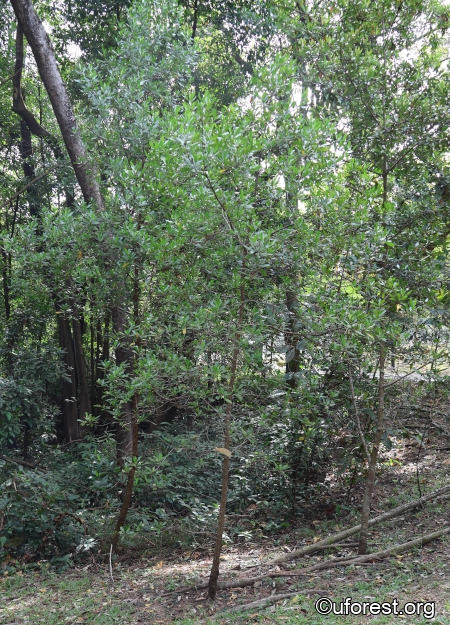
A young stand cultivated at Pasir Ris Mangrove.
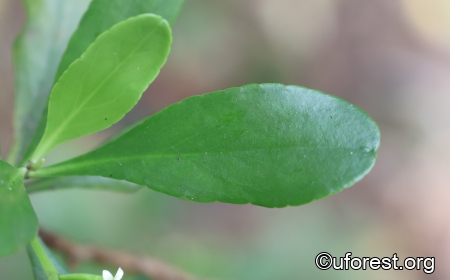
Leaf, note the notches along the margins.
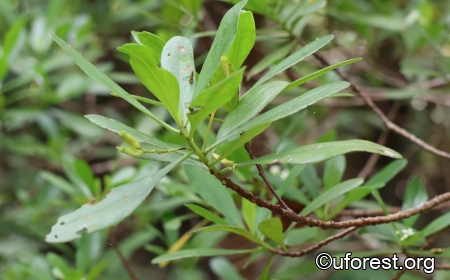
Leafy branch.
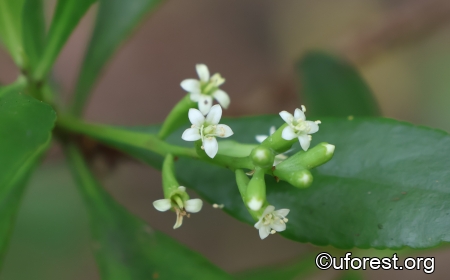
White flowers.
References
Giesen W, Wulffraat S, Zieren M & Scholten L (2006) Mangrove guidebook for Southeast Asia. RAP Publication 2006/07. FAO Regional Office for Asia and the Pacific and Wetlands International. Bangkok. 769 pp.