Mimosa pudica L.
| Etymology | Genus | Mimic; referring to the fact that the leaf respond to stimuli |
|---|---|---|
| Species | Chaste, bashful; referring to the closing of the leaflets upon touch | |
| Family | Fabaceae | |
| Synonyms | - | |
| Common Names | Mimosa, Touch Me Not, Sensitive Plant | |
| Status | Exotic: Naturalised | |
| Form | Creeping herb or shrub | |
| Native Distribution | Tropical South America | |
Diagnostics
Mimosa pudica very common as a weed in lawns and scrublands. This seems to be the only species with sensitive leaves that can be found in frequently manicured lawns because it can survive well in a prostrate habit.
In wastelands, other closely related plants with similar leaves that are sensitive are Neptunia and other Mimosa species. However, the pink-colour flower clusters and the bipinnate compound leaves which only have one to two pairs of leaflet-bearing stalks are enough to filter away other species.
Interesting Facts
This is THE Mimosa which everyone fondly played with when they were young. A light touch to the leaflets releases a chemical that causes the rapid movement of water out of the vacuoles, leading to cell collaspe. This process occurs at glands situated at the end of each leaflets, thereby causing the leaflets to fold (Davis & Johnson, 2012). The hypothesis for this trait is to deter herbivores; either by surprise because of its sudden movement, or the difficultly of perching on the leaf.
The pom-pom like flowers consists of extended pink filaments ending with white anthers, which make out the overall rounded appearance. The pistil is short and barely visible among the stamens.
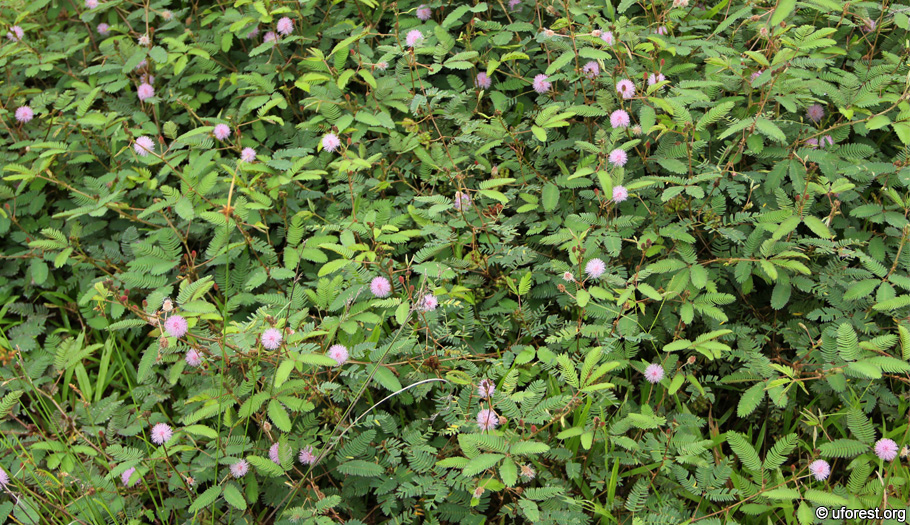
A grass patch engulfed with Mimosa pudica.
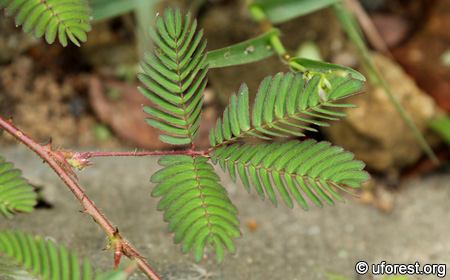
Bipinnate leaf of Mimosa. It normally bears one or two pairs of stalks.
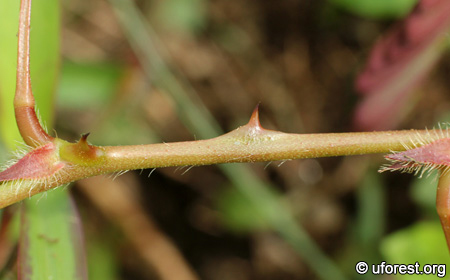
Prickles occur in pairs at the nodes and singly along the stems.
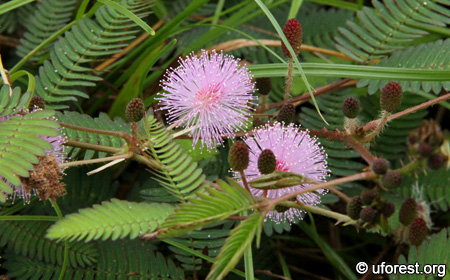
Pink flower clusters, with young flower buds around.
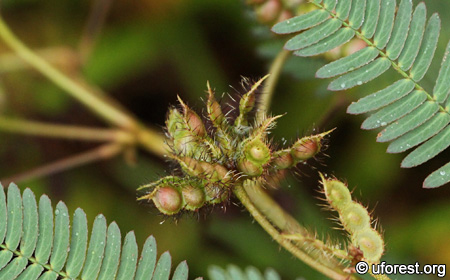
Spiny fruit pods.