Momordica cochinchinensis (Lour.) Spreng.
| Etymology | Genus | To bite, reference to the seeds which look like they are bitten |
|---|---|---|
| Species | After Cochinchina, a region which is now part of south Vietnam | |
| Family | Cucurbitaceae | |
| Synonyms | Muricia cochinchinensis Lour. | |
| Common Names | Spiny Bitter Gourd, Gấc | |
| Status | Exotic: Casual | |
| Form | Climber | |
| Native Distribution | Southeast Asia | |
Diagnostics
A climber that only grows in cultivation here, it has trilobed leaves, though leaf shape is said to be highly variable. The round fruit is distinct, bring covered in tiny spines and ripen from green to yellow and then orange.
Interesting Facts
The fruits are consumed for dietary and medicinal uses, especially by the Vietnamese. There, the aril of the ripe fruit is widely used as a rice colorant due to the extraordinarily rich concentration of lycopene (Vuong, et al., 2006). It also contains contains high levels of beta-carotene and alpha-tocopherol.

The Spiny Bitter Gourd, in the Edible Pavilion Garden, 2020.

Trilobed leaf.

Tendrils.
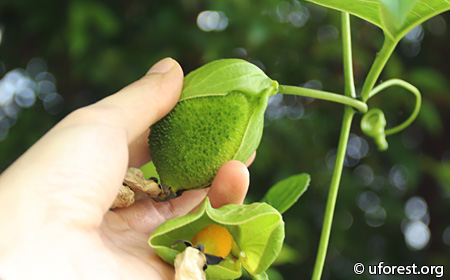
Developing fruit.

Fruits.
References
Vuong LT, Franke AA, Custer LJ, Murphy SP (2006) Momordica cochinchinensis Spreng. (gac) fruit carotenoids reevaluated. Journal of Food Composition and Analysis 19: 664-668