Sonneratia caseolaris (L.) Engl.
| Etymology | Genus | After 19th century French botanist Pierre Sonnerat |
|---|---|---|
| Species | - | |
| Family | Lythraceae | |
| Synonyms | Rhizophora caseolaris L. | |
| Common Names | Berembang, Mangrove Apple | |
| Status | Native: Critically Endangered | |
| Form | Tree | |
| Native Distribution | From India, through Southeast Asia, Australia and Pacific Islands | |
Diagnostics
A true mangrove species that can be easily distinguished from others from its opposite and elliptic leaves, and large conical peumatophores. The branches have a characteristic droop. The flowers have many stamens, being pink at the base and white at the tips.
It is considered a rare tree found naturally in Singapore, being isolated to a few trees at Sungei Seletar, Kranji Nature Trail, Berlayar Creek, Pulau Ubin and Pulau Tekong and Woodlands Town Garden, but have also been cultivated at Sungei Buloh and Pasir Ris (Yeo, 2011; Tan, 2016).
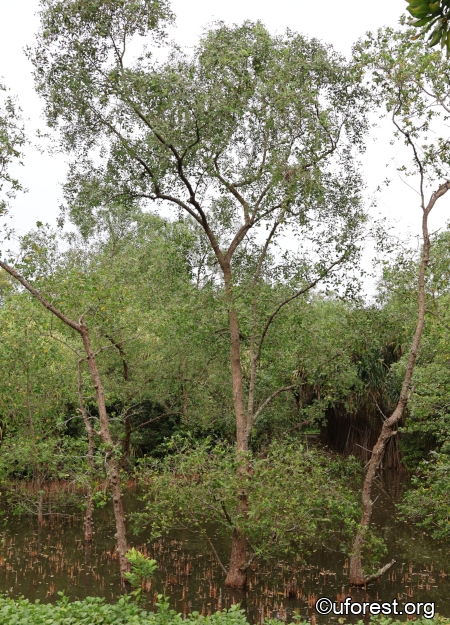
Cultivated trees at Pasir Ris Park.
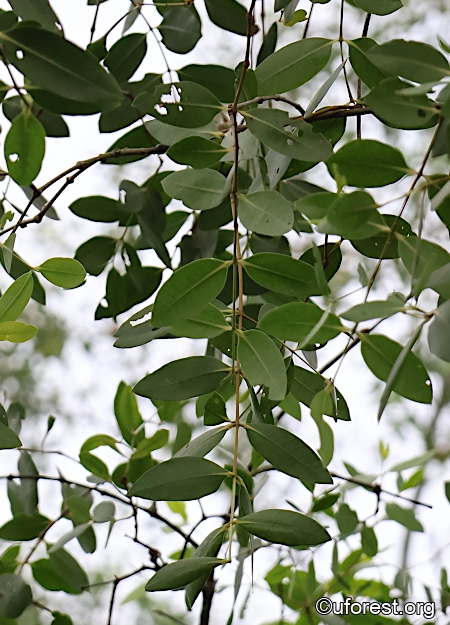
Drooping branch. Note the elliptic leaves with pointed tips.
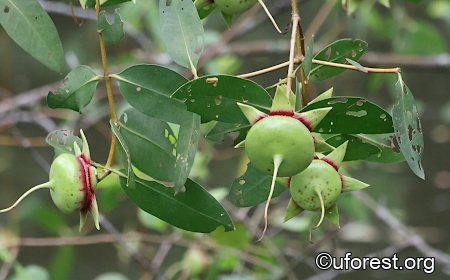
Fruits.
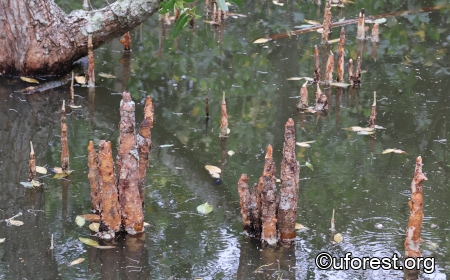
Conical pneumatophores .
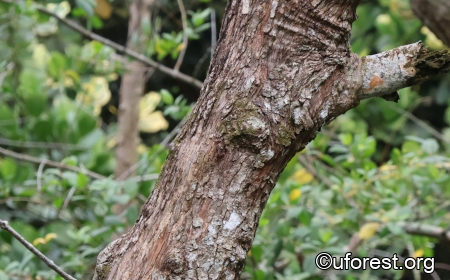
Bark.
References
Tan R. (2016) Berembang Sonneratia caseolaris, Wild Singapore, http://www.wildsingapore.com. Accessed at 18-Jan-2026.
Yeo R. (2011) Berembang (Sonneratia caseolaris). tiderchaser.blogspot.com. Accessed at 18-Jan-2026.