Volkameria inermis L.
| Etymology | Genus | After the botanist Johann Georg Volkamer |
|---|---|---|
| Species | Not spiny | |
| Family | Lamiaceae | |
| Synonyms | Clerodendrum inerme (L.) Gaertn. | |
| Common Names | Wild Jasmine, Seaside Clerodendrum | |
| Status | Native: Least Concern | |
| Form | Shrub | |
| Native Distribution | China, Japan, Indian Subcontinent, Indochina, Malesia, Pacific Islands, Australia | |
Diagnostics
A common shrub found in coastal areas, with droopy branches. The leaves are opposite, ovate or elliptic. The flowers are white petaled, tubular, and with very long red-purple stamens. Parts of the twigs and petioles might be purple too.
Interesting Facts
From Giesen et al. (2006), a concoction from the leaves is used to treat wounds, and as an appetizer dish in Indonesia. The fruit is also used to treat dysentery.

A small cluster of Seaside Clerodendrum at Punggol Beach, 2020.

Flowers.

Leaf upper and lower surfaces.
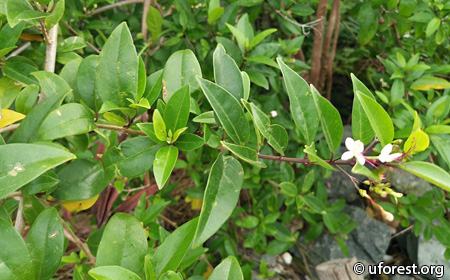
A branch.

Twig.
References
Giesen W, Wulffraat S, Zieren M & Scholten L (2006) Mangrove guidebook for Southeast Asia. RAP Publication 2006/07. FAO Regional Office for Asia and the Pacific and Wetlands International. Bangkok. 769 pp.
Siyang ·
2020-02-23 / Modified: 2020-02-25