Nepenthes gracilis Korth
| Etymology | Genus | An anti-depression (Nepenthe) used by Helen of Troy on her guests in Greek mythology |
|---|---|---|
| Species | Graceful or slender, in reference to the shape of the pitchers | |
| Family | Nepenthaceae | |
| Synonyms | - | |
| Common Names | Slender Pitcher Plant | |
| Status | Native: Least Concern | |
| Form | HabitHerbaceous or woody climber, or herb | |
| Native Distribution | Malesia (Peninsular Malaysia, Sumatra, Borneo, and Sulawesi) | |
Diagnostics
The leaf wing of this species is well-developed compared to the two other species that can be found in Singapore, i.e., Nepenthes ampullaria and N. rafflesiana. The leaf blade itself is also much narrower. The pitcher itself is uniquely shaped; both upper and lower pitchers are slender, elongated, and have a slight pinched centre.
Interesting Facts
This is the most common and widespread pitcher plant species in Singapore. The reason, as aptly explained by Chan et al. (1997), is due to fact that the Slender Pitcher Plant is tolerant of pollution and can grow in a diverse range of soil conditions.
The lower pitcher of this plant is characterised by the hairy fringed wing. This portion is very much reduced in the upper pitcher, with no hairs on the fringed wing. Completely maroon-coloured pitchers can also be seen sometimes, but they are not as common as the green-coloured ones. Their sizes varies greatly, especially for those growing on regularly mowed lawns can be shorter than 1.5 cm in length!

Upper pitchers with its hairless fringed wing.
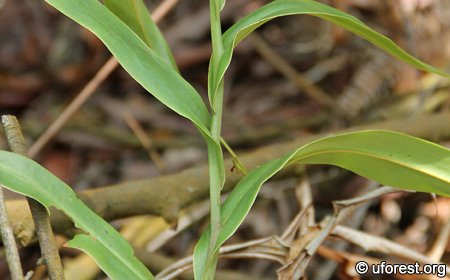
Very developed leaf wings is a character of Nepenthes gracilis.
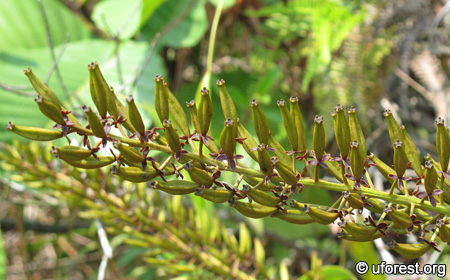
Fruits of the Slender Pitcher Plant.
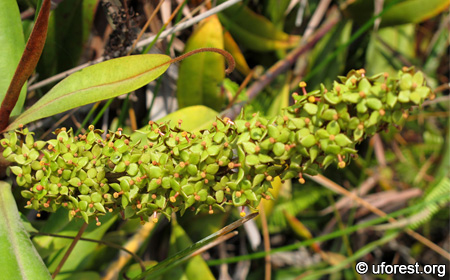
Male inflorescence.
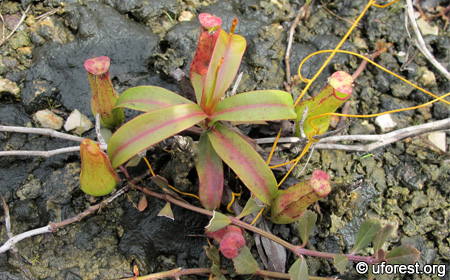
A herb form with the leaves arranged in a rosette with lower pitchers.
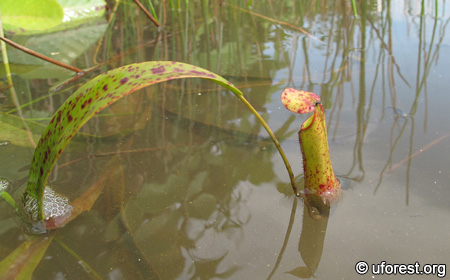
The Slender Pitcher Plant can survive well even in waterlogged conditions.

A crab spider hiding in the pitcher mouth to steal the pitcher's prey.